Everyone Points At Recruitment When It Goes Wrong. Almost Nobody Asks Who Actually Made The Decision.
On my 11th day in recruitment, I placed my first candidate. Alone — no senior closing it for me, no split desk. I celebrated with a bar of Cadbury chocolate, because that’s what I could afford to celebrate with back then and Cadbury was my first client.
She was a hijabi candidate who’d been struggling in her job search — not because she couldn’t do the work, but because of what people decided about her before she opened her mouth. I got her placed. Something in me clicked that day and never left. I didn’t get into recruitment to fill headcount. I got into it because I wanted to help people who kept getting overlooked get picked. That’s the part people misunderstand about this job. It isn’t HR. It isn’t interviewing. It isn’t glamorous. It’s sales — you’re influencing a client and a candidate at the same time, matchmaking two people around something that isn’t small. For the candidate, it’s their rice bowl. For the client, it’s business impact. None of it is straightforward.
I spent ten years in agency and did well. I bought my first apartment at 28 with no family money behind me — I wasn’t born into any of this. I got my first car in 2008, red plate and all, which anyone who’s fought the COE system on a normal income knows is its own war. I built that decade myself, one placement at a time.
Then came the hardest personal stretch of my life. A nasty divorce that took more out of me than I expected, and I won’t pretend everyone around me made it easier — some people I’d worked alongside kicked me further down when I was already struggling. That’s a different story for a different day. What I’ll say is: I decided it was time to move. From agency into in-house, at a Fortune 500 tech company, brought in to manage, transform and revitalise the entire APAC recruitment region — 20-plus countries, 50 offices, multiple regions, reporting into Dutch HQ. Japan, China, Taiwan, Hong Kong, Korea among them. A huge mandate. Genuinely exciting. I was looking forward to clocking another ten years in-house.
It was short-lived for 6 years. Three things, really.
One — the politics were crazier than I’d braced for. Most of the people sitting in hiring decisions weren’t focused on what was right for the business. They were hiring whoever was right for their own self-interest — building alliances, not teams. That ripples. It made the culture worse in a way that compounds on itself.
Two — I was carrying more than the job alone. Pulled top-down and sideways by senior stakeholders, hiring managers, my own team, and regional peers across 20-plus countries, I worked longer hours than the role required — and honestly, at the time, that suited me. It gave me somewhere to put myself while I was still recovering from the divorce and managing ageing, ill parents at home. The burden was heavy, and I didn’t have much good support underneath it. On top of that, Dutch HQ ran on too much process — layers of it, much of it unnecessary, that slowed down work that didn’t need slowing down.
Three — skills lost to nepotism, over and over. The majority of people weren’t hiring on ability. They were hiring on likability — bringing in allies to strengthen their own position, regardless of how underqualified. It was like watching Game of Thrones with a headcount budget. That genuinely saddened me, because all I wanted to do was build a high-performing recruitment function that actually helped leaders, the business, and candidates. And when restructuring came — which I understand is sometimes necessary — it wasn’t the underperformers who got removed. It was the people the leadership liked least, even when those people had done the work, proven themselves, and delivered.
I moved again, to a global industrial chemicals company, an even larger region this time — APMEA, stretching from Morocco through Africa all the way to Japan. I had a boss there I respect enormously, Antonio Lopez. He always had my back, and he believed in talent acquisition the way I did — not as a cost centre, but as a function that deserved a real seat at the table. That mattered more than most people realise.
This environment was different, and in some ways harder. Male-dominated industry, private-equity-owned, and the male egos multiplied the same politics I’d already seen elsewhere. There was no shared process across the region — every country ran recruitment its own way. Some of that I understood; local nuance is real. But some of it was genuinely wild-west: compliance gaps, discrimination nobody was catching, confidential candidate information handled carelessly. My job was to centralise all of it — 28-plus countries, that many cultures — starting from a blank sheet of paper. Dismantle what wasn’t working, rebuild what should exist instead, and turn a team that had been sitting back waiting for applications to land into one that actively scouted and built talent pipelines ahead of need.
I loved that mandate. I’m a builder and a fixer — I get restless doing pure maintenance. I also loved a part of the role people rarely associate with recruitment: employer branding. Marketing. Building awareness, localising content for different markets, the sheer variety of people you get to work with across regions. That part of the job is mine, genuinely, not a means to an end.
To be clear — I’m not saying I am not good at my job haha and neither am I complaining about stakeholder management itself. Some people are brilliant at that game and thrive in it, and I respect that skill. I just have a lower threshold for people who are there purely for the politics and not for the actual work. I know it’s unavoidable. It’s just never been my favourite part.
Here’s the pattern that repeated in both seats, and it’s the thing I need to say plainly, because Stuart Jones — Sales Director Asia at Indeed, and someone who lived the same reality in-house at Cisco, S&P Global and Bank of America — said the same thing on the podcast “Any Talent Acquisition person that works on site is probably one of the hardest roles I’ve ever been involved with” and my partner has said it to me privately for years: “talent acquisition is one of the most thankless jobs there is.” When a hire goes right, nobody says a word. When it goes wrong, everyone points at TA — even when TA was the one raising every red flag, every warning, every reminder, and got overruled anyway by the same stakeholders who made the call. Stuart’s words, not mine: “Your stakeholders are one door away.” And on what happens when a hire fails: the impact “could trickle right the way down to talent acquisition as well.” On the nepotism I watched play out twice, in two very different companies: “Not every human being can walk a straight line — biases, influence, the need to potentially appease someone else, always pops into decision making.” I’m not the only one who’s seen this. It’s just rarely said out loud by the people who benefit from it staying quiet.
That’s a large part of why I built Substance. I get to do recruitment the way I always believed it should be done — and I’m loving every bit of it. Would I go in-house again? I won’t say never. For the right leader — someone like Antonio Lopez, who actually has your back — I’d do it again without hesitation. Maybe a different region. Who knows.
But the person who placed that first candidate on day 11, with nothing but a bar of Cadbury and the conviction that everyone deserves a fair shot, is still the one running the show. Nothing about the years in between changed that.
About Stuart Jones
Stuart leads Indeed’s sales efforts across Asia, partnering with employers to build data-driven hiring strategies that help them find and hire the right talent faster. With deep experience across digital recruitment and labour market trends, he works closely with HR and business leaders to design solutions that tackle their most pressing hiring challenges.

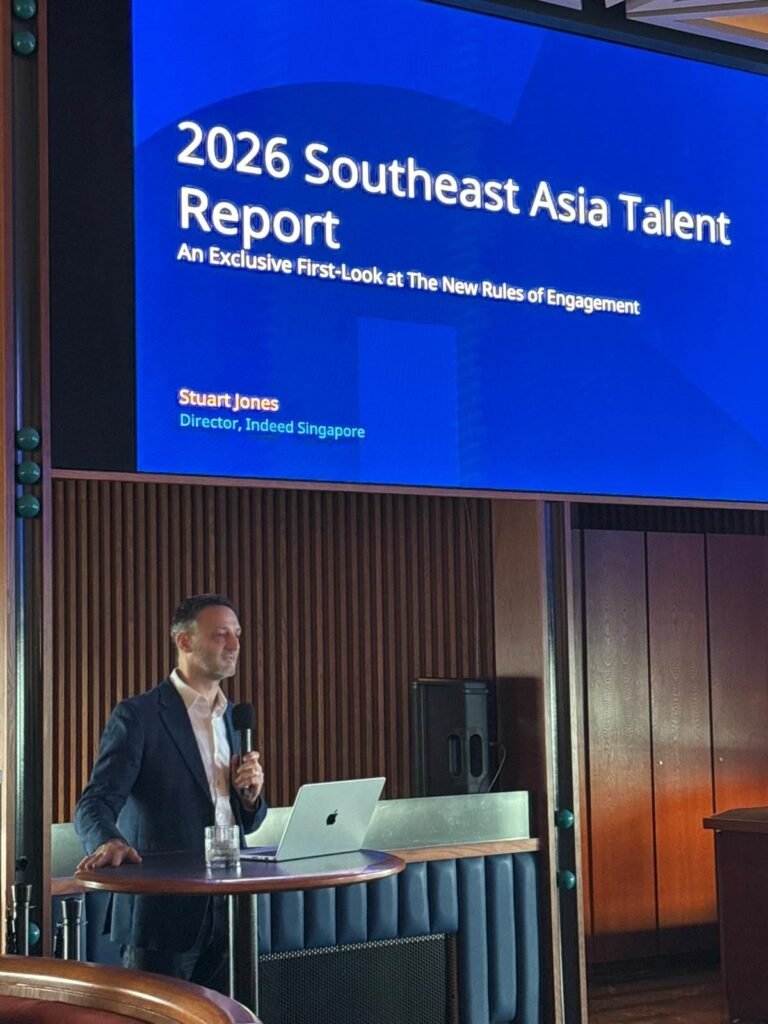
Stuart Jones at 00:53